

Title
PhD Scholarship: Cranial Evolution, Digital Morphology, and Palaeobiology of Fishes (Early Vertebrates)
College
College of Science and Engineering
Opening date
16-11-2026
Closing date
15-01-2027
Scholarship value
$37,143 p.a.
Scholarship duration
3.5 years
Payment term
fortnightly
Level of Study
Higher Degrees Research
Description
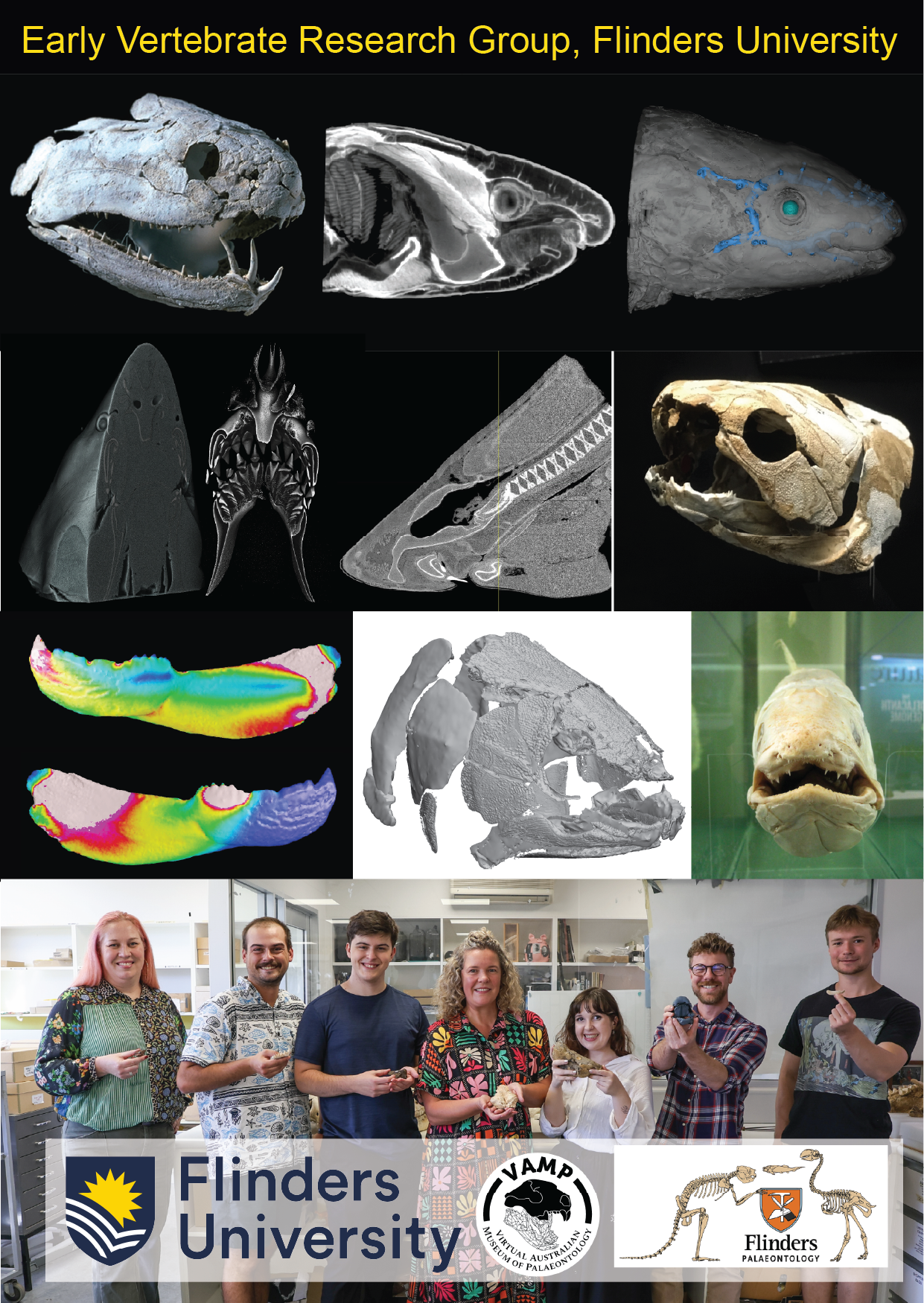
We are seeking two outstanding candidates for PhD scholarships for an evolutionary biology project entitled: Cranial Evolution, Digital Morphology, and Palaeobiology of Fishes (Early Vertebrates). This exciting Australian Research Council-funded project is led by Dr Alice Clement (https://www.flinders.edu.au/people/alice.clement) and based at Flinders University, Adelaide, Australia, with links to several other national and international research institutions and collaborators.
The project has two funded PhD scholarships, proposed to be in the areas of: 1, evolution and palaeobiology of coelacanth fishes; and 2, cranial anatomy, morphology and biomechanics of living sharks (although other relevant projects can be proposed by the applicant).
Both of these evolutionary biology-based projects will unite ‘digital’ morphology with cranial evolution of fishes (either chondrichthyans or osteichthyans), relying heavily on synchrotron imaging of exceptional and rare specimens. Project 1 will examine coelacanth evolution using fossils from the Palaeozoic and Mesozoic, and scans of the living Indonesian coelacanth (Latimeria menadoensis); while Project 2 uses a synchrotron-imaged ontogenetic sequence of white shark (Carcharodon) specimens, as well as a range of other living sharks from Australia.
The successful applicants will join a vibrant Early Vertebrates Research Group, led by Dr Alice Clement, within the Palaeontology Lab at Flinders University, Australia. Students will be co-supervised either by researchers in the palaeontology group, and/or the Southern Shark Ecology Group (SSEG) dependent upon project. Students will have the opportunity to conduct field work, museum collection visits, gain experience using the Australian Synchrotron, and share results of their project via national and international conferences.
Benefits
The scholarship includes:
Eligibility
To be eligible for the award of this scholarship a student must:
Selection Criteria
ESSENTIAL KNOWLEDGE AND EXPERIENCE
DESIRABLE KNOWLEDGE AND EXPERIENCE
ADMISSION to HDR
Those who apply for the scholarship opportunity that have not already applied for admission to a relevant HDR must also apply. Instructions on how to apply for admission can be found here: https://www.flinders.edu.au/study/apply/apply-research-degree/how-to-apply
By lodging this separate application, applicants acknowledge:
APPLICATION
Prior to submitting an application for the scholarship, prospective applicants are advised to contact the Project Lead Investigator, Dr Alice Clement via email (alice.clement@flinders.edu.au) to discuss your interest and eligibility in the opportunity. The Project Lead Investigator may invite you to apply and request a copy of your CV, together with a two-page covering letter outlining your relevant qualifications, experience, research experience and reasons for applying for the scholarship.
The application for admission and the scholarship will be separate processes; applications for admission to candidature are submitted electronically.
Scholarship applications are to be submitted via email at: XXXXXXX@flinders.edu.au
The successful candidate will ideally begin by July 1st 2027, subject to negotiation (and not later than December 31st 2027).
Sturt Rd, Bedford Park
South Australia 5042
South Australia | Northern Territory
Global | Online
CRICOS Provider: 00114A TEQSA Provider ID: PRV12097 TEQSA category: Australian University