Core Topics
- Introduction to Substance Use and Behavioural Dependence
- Social Determinants of Health and Wellbeing
- Health Promotion in Public Health
- Public Health Policy, Equity, and Advocacy
Why study Substance and Behavioural Dependence at Flinders?
Advance your skills in working with people, communities and populations experiencing substance use and behavioural dependence. In this Graduate Certificate, you'll develop the expert knowledge and practical skills needed to promote positive change for people and communities living with substance use, gambling and other behavioural dependencies. Along the way you will your advance your career in health, counselling, community services or social work. Designed for working professionals and delivered 100% online you can apply what you learn directly to your workplace.
Evidence-informed teaching
Explore public health theory to inform policy, advocacy, and prevention in the context of substance use and behavioural dependence.
Up to 80% off fees
Government subsidies offer Domestic applicants a reduction of up to 80% off full course fees through Commonwealth Supported Places. Offer subject to change.
Learn from research experts
Draw on Flinders’ public health research and develop the skills to translate from practice to evidence-informed policy.
Create meaningful impact
Develop strength-based approaches to work with rural and remote communities, including First Nations peoples.
You’ll complete four core topics, building a strong foundation in Public Health while exploring prevention, harm minimisation and stigma reduction across areas including alcohol and other drugs, nicotine, vaping, gambling and maladaptive online behaviours.
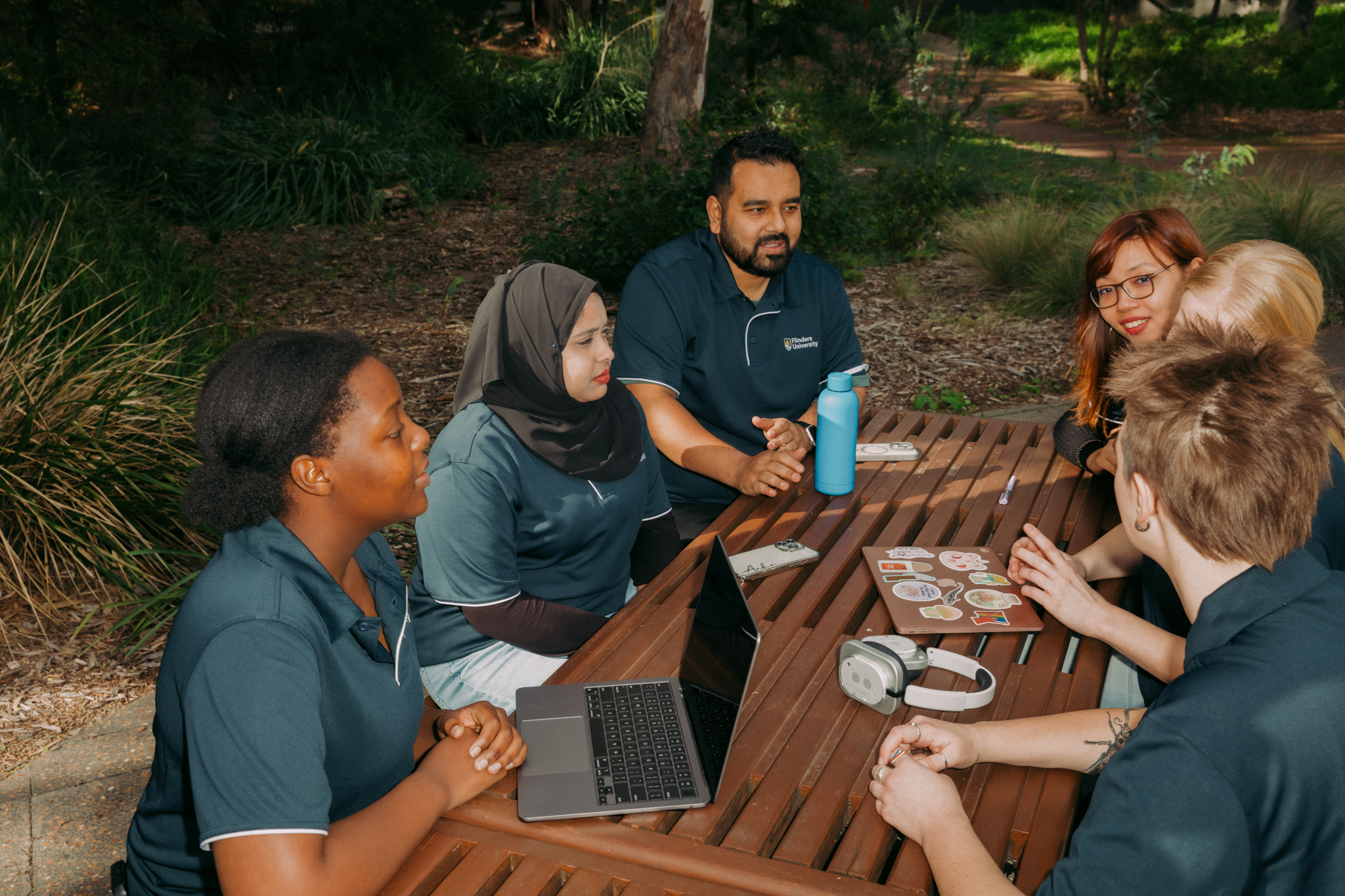
Broaden your opportunities across sectors responding to substance use and behavioural dependence. This qualification can support careers across health, community and social services, law enforcement, corrections, clinical and allied health, as well as roles in policy, program development and research.
You could be a
Expected salary
$100,000*

Expected salary
$120,000*
Expected salary
$100,000*
Expected salary
$120,000*
You could be a
Expected salary
$100,000*
Expected salary
$120,000*
Expected salary
$100,000*
Expected salary
$120,000*
*Typical salaries are drawn from a variety of sources, including Seek, Glassdoor and Indeed, and may vary. Please do your own research.
This course is informed by leading addiction researchers and industry partners working across health, mental health, community and social services settings, including the Flinders Health and Medical Research Institute (FHMRI), the International Centre for Point-of-Care Testing (iPOCT), the Poche SA+NT Centre for Indigenous Health, and the National Centre for Education and Training on Addiction (NCETA)
Flinders University is ranked top 2% globally
Top 150 in the world for Public Health**
Gain practical skills through industry-simulated projects
Flexible online study - anywhere, anytime
*THE World University Rankings 2023
**2025 Global Ranking of Academic Subjects
Meet your academics
Our incredible teaching staff are experts in their fields and well-connected to the industry.
Dr Amy Hickman
Course Coordinator
Lecturer in Public Health, teaching Health Promotion within the Master of Public Health. Her work focuses on equity, health communication, and inclusive teaching, with a strong interest in reflexivity, health literacy, and qualitative research.
Dr Joshua Trigg
Lecturer
Expertise in health risk behaviours, tobacco control, and alcohol consumption. His research explores attitudes and motivators that shape risk behaviours, as well as the effectiveness of health promotion messaging.
Dr Cheryl Shelbach
Lecturer
Teaching specialist in Public Health, who is involved in both postgraduate and undergraduate programs. She is interested in ensuring that curricular strategies relating to AI (Artificial Intelligence).
The Graduate Certificate in Substance and Behavioural Dependence is a 12-month part-time program that can lead into the Master of Public Health*. It gives you the flexibility to upskill in stages, taking the next step in your career when the time is right.
*You’ll need to apply and be admitted into the Masters degree, with credit available for topics already completed.
over 12-months of part-time study complete the
Graduate Certificate in Substance
and Behavioural Dependence
Study over 2 years full-time
(1.5 years accelerated option also available)
to earn the Master of Public Health
Find the answers to some of our most frequently asked questions.
Substance and behavioural dependence can encompass a range of behaviours and substances that can negatively affect individual and community health. In this course, you’ll explore areas including alcohol and other drugs, nicotine, vaping, gambling, and maladaptive online behaviours through a public health and prevention lens.
The course is designed for current and future professionals interested in preventing and reducing the harms associated with substance use and behavioural dependence. It is particularly relevant to those working across health, welfare, community and social services, law enforcement, corrections, clinical and allied health sectors.
Some courses have Commonwealth supported places (CSP) available for domestic students, which means the course is subsidised by the Commonwealth Government. A CSP student will pay this subsidised fee as their student contribution.
Alternatively, a full-fee-paying (FFP) place refers to a course that is not subsidised by the Commonwealth Government, or a course that has filled all available CSP places. A FFP student will pay this fee in its entirety.
Some courses may have both CSP and FFP places available.
The course takes a broad approach to dependence, including alcohol and other drugs, nicotine, gambling and maladaptive online behaviours.
The course has a strong public health and prevention focus. You’ll explore contemporary approaches to prevention, harm minimisation and stigma reduction, as well as how research can inform programs, policy and community-level interventions.
Yes. You’ll develop skills in designing and co-designing strength-based strategies with priority populations, including rural and remote communities, First Nations peoples, and culturally and linguistically diverse communities.
Select your preferred course.
Check the entry requirements and your eligibility.
Confirm the key application and enrolment dates.
Apply and submit your application via Direct Entry.
Flinders Online courses are available for Australian or New Zealand citizens, Australian permanent residents, holders of Australian permanent humanitarian visas and Pacific Engagement visa holders.
International students in Australia who hold a student visa are not eligible to apply.
For further information regarding course eligibility, refer to the individual entry requirements for each course.
You are encouraged to apply as soon as possible and by no later than teaching commencement dates. If places fill, applications for your preferred start date may close without notice and you will be considered for the next available intake.
Please refer to the individual Flinders Online course for more information.
Applications are submitted directly with Flinders.
You can apply for up to three courses in order of preference in your application. More information is available in the Application Guide.
Normally, we will inform you of the outcome of your application within 3-5 working days after submission.
If further information is required, we will contact you via email with details on what is needed and how to provide it.
Yes, government-supported HECS-HELP and FEE-HELP loan area available to help eligible students pay for their higher education tuition fees.
Both loans are indexed to reflect changes in the cost of living but are otherwise interest free. HELP Loans must be repaid through the tax system once your income reaches a certain threshold, with payments increasing as your earnings rise.
CRICOS Provider: 00114A TEQSA Provider ID: PRV12097 TEQSA category: Australian University
CRICOS Provider: 00114A
TEQSA Provider ID: PRV12097
TEQSA category: Australian University
Flinders University uses cookies to ensure website functionality, personalisation and a variety of purposes as set out in its website privacy statement. This statement explains cookies and their use by Flinders.
If you consent to the use of our cookies then please click the button below:
If you do not consent to the use of all our cookies then please click the button below. Clicking this button will result in all cookies being rejected except for those that are required for essential functionality on our website.